

A dying car battery usually gives warning before it quits: the engine cranks slower than it used to, the headlights dim at startup, the dash flickers, or the car needs a jump after sitting overnight. If you see any of these, have the battery and charging system tested soon, before you get stranded. A battery that is a few years old and showing symptoms is rarely going to get better on its own.
This guide covers the signs of a weak battery, how to separate a bad battery from a bad alternator, why a battery can die overnight, and when a recharge is enough versus when you need a new one.
TL;DR
- The most common warning signs are slow cranking, clicking when you turn the key, dim lights, flickering dash lights and repeated jump-starts.
- Most car batteries last three to five years, and hot regions wear them out sooner, which matters in a Texas summer.
- A battery that dies overnight, or keeps dying, may point to a parasitic drain or a charging problem, not only an old battery.
- A resting reading near 12.6 volts is healthy. A load test is the reliable way to confirm a failing battery.
- If the car will not start, shows a battery light or smells of sulfur, have it inspected by a professional.
Table of Contents
- The Warning Signs of a Dying Car Battery
- Is It the Battery or the Alternator?
- Why a Battery Dies Overnight or Keeps Dying
- Dead, Weak or Just Needs a Jump?
- How a Battery Is Properly Tested
- How to Make a Battery Last Longer
- When to Replace the Battery
- Our Perspective
- Battery and Charging System Service in Plano
- FAQ
- Sources
The Warning Signs of a Dying Car Battery
No single symptom proves the battery is the problem, but a pattern of them usually does. Here is what we see most often, roughly from the earliest sign to the most obvious.
1. Slow, sluggish cranking
The engine turns over more slowly than usual, with a drawn-out sound before it fires. This is often the first symptom, and it tends to show up on the first start of the day. AutoZone lists slow cranking among the typical signs of a weak battery, along with flickering dash lights at startup.
2. Clicking and no start
A rapid clicking when you turn the key means there is not enough power to turn the starter. The dash may light up normally while the engine does nothing. That can be a flat battery, but it can also be corroded or loose terminals, so a visual check matters.
3. Dim headlights and interior lights
Lights that look weaker than usual, especially at idle or when you start the car, suggest the battery is struggling to supply current. Lights that brighten when you rev the engine can point toward the charging system instead.
4. Electrical oddities
Power windows that move slowly, a radio that resets, heated seats that will not turn on or a flickering dashboard can all appear when voltage is low. Modern vehicles have many modules that react badly to low voltage, so odd warning lights can be an early clue.
5. A battery or charging warning light
The battery-shaped light on the dash signals a charging system fault. It does not always mean the battery itself has failed. It can mean the alternator is not keeping the battery charged.
6. Corrosion on the terminals
White, blue or green crusty buildup around the posts can interfere with current flow. Our guide to corrosion on a car battery explains what causes it and how it is cleaned.
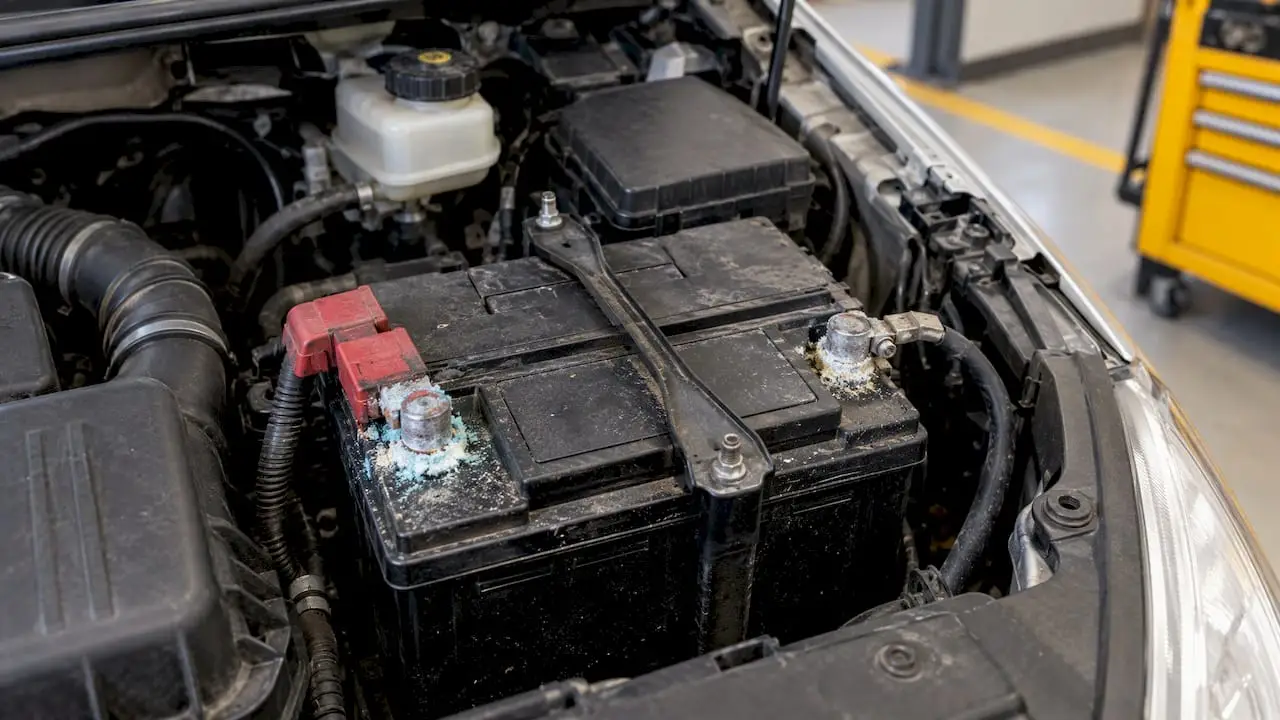
7. A swollen or leaking case
A bulging case or any sign of leaking is a safety issue. Heat can cause a case to swell. A battery in this condition should be replaced, not recharged.
8. A rotten-egg smell
A sulfur smell near the battery can mean it is leaking gas or overheating. Keep sparks and flames away and have the vehicle inspected promptly. Lead-acid batteries can give off explosive gas and contain acid, which is why safe testing practices include eye protection and care around terminals.
9. Needing a jump again and again
One jump-start after leaving a light on is an accident. Two or three in a few weeks is a pattern. If you are not sure how to do it correctly, read how to jump-start a car battery safely first.
Is It the Battery or the Alternator?
The battery starts the car. The alternator recharges the battery and runs the electrical system while the engine is on. When either one fails, the symptoms overlap, which is why people replace a battery and still have the same trouble.
These patterns help narrow it down:
| What happens | More likely cause |
|---|---|
| Cranks slowly or clicks, but runs fine after a jump and stays running | Worn-out battery |
| Starts after a jump, then dies again once shut off | Battery that will not hold a charge |
| Car starts, then stalls soon after | Charging system, often the alternator |
| Battery light stays on while driving | Charging system |
| Lights dim or flicker as engine speed changes | Alternator |
| Burning smell or whining from the alternator area | Alternator |
The first rows come from the pattern AutoZone describes: if the car runs fine after a jump and does not die while driving, the battery may simply be worn out. A roadside advice page lists the stalling, warning light and flickering patterns as signs of the alternator.
For a deeper walk-through, see our alternator vs battery guide and our alternator failure diagnostic guide.
What voltage readings tell you
A technician checks voltage with a multimeter. Typical reference numbers:
- Engine off, accessories off: about 12.6 volts is a healthy, fully charged battery. Fluke notes that 12.4 volts is roughly 75% charged, 12.2 volts about 50%, and below 12.0 volts the battery is likely discharged or weak.
- Engine running: a healthy charging system typically reads in the range of 13.7 to 14.7 volts, per the same source. Different manufacturers publish slightly different ranges, so the vehicle’s own specification is the final word.
- Resting time: Haynes recommends letting the battery sit for at least an hour before measuring, so the reading is accurate.
Voltage alone does not tell you how much life is left. A battery can show decent resting voltage and still collapse under the load of the starter. That is why a load test matters.
Why a Battery Dies Overnight or Keeps Dying
A healthy battery should not go flat overnight. When it does, there are three usual suspects: an aging battery that cannot hold a charge, a charging system that is not replacing what you use, or a parasitic drain.
Parasitic drain
A parasitic drain is something drawing power after the car is off. Common culprits include a dome or trunk light that stays on, a phone charger or dash cam left plugged in, a stuck relay, a badly wired aftermarket stereo or alarm, or a module that never goes to sleep.
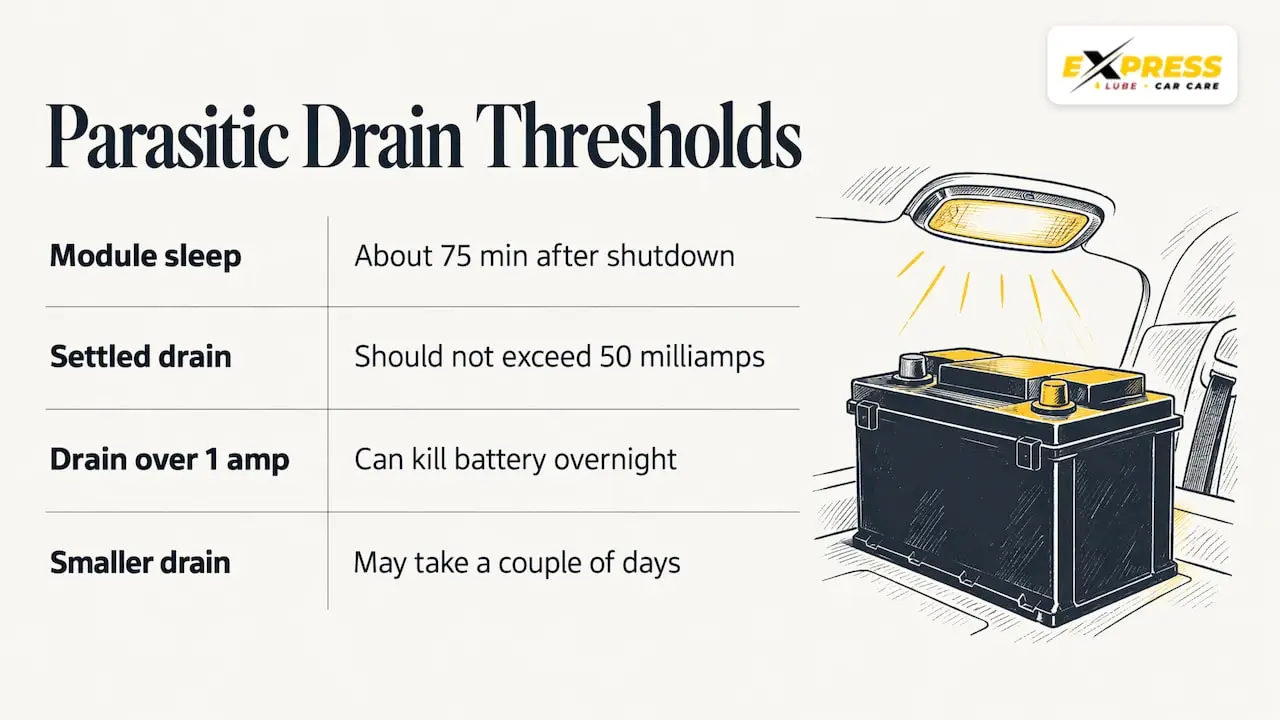
There is a number behind this. MOTOR magazine explains that vehicle modules should enter sleep mode within about 75 minutes after the ignition is off and the doors are closed, after which the drain should not exceed 50 milliamps. A drain over one amp can commonly kill a battery overnight, while a smaller one may take a couple of days.
Finding the source is methodical work: tracing which circuit stays live. If you want the details of how a technician approaches it, see our overnight battery drain diagnostic guide and the multimeter check for parasitic battery drain. Because the test involves disconnecting battery cables and pulling fuses on modern electronics, we suggest having it done by a shop.
Heat, age and vibration
Batteries wear out even when nothing is wrong with the car. Consumer Reports cites research showing life averaging 58 months or more in the farthest northern U.S. regions and less than 41 months in the most southern ones. It also notes AAA’s finding that excessive vibration can shorten battery life. For drivers in North Texas, that means planning around the shorter end of the three-to-five-year range.
Short trips and long sitting
Starting the engine takes a big bite of battery energy, and short drives may not replace it. A vehicle that sits for weeks can also go flat. Idling in the driveway is not a good fix either: OPTIMA explains that idling may drain a battery faster than leaving it alone if the engine does not run long enough or fast enough to replace the energy used.
A failing alternator can look like a bad battery
A charging system that undercharges will keep killing new batteries. An alternator problem is often the real reason behind a battery that keeps dying, which is why we test both together.
Dead, Weak or Just Needs a Jump?
This is the question that matters on the driveway.
- If a jump starts the car and it keeps running well for days, the battery was probably drained by something one-off, like a light left on. Have it tested anyway if it is more than a few years old.
- If it needs a jump every few days, the battery is no longer holding charge, or something is draining or undercharging it.
- If it dies right after being jumped, suspect the charging system.
- If a jump does nothing and you hear only clicks, check for loose or corroded terminals, and call for help rather than repeatedly trying.
The difference between a drained battery and a failed one often comes down to age and history. Batteries Plus explains that deep discharge can permanently damage a standard lead-acid battery, and that one that is over four years old, has been dead for weeks or is visibly bulging cannot be revived. A relatively new battery drained by a light left on can often be recovered with a proper smart charger. A jump pack or jumper cables are not chargers, so a battery that was deeply drained should be properly recharged. Our guide to charging a car battery safely covers the basics.
If you want a second walkthrough of the decision, Garage BRO’s dead battery guide covers how to tell, fix and prevent a recurring dead battery.
How a Battery Is Properly Tested
Two checks matter most, and a shop does both.
- Visual inspection. DENSO’s guidance says to check that the case is not cracked, bulging or leaking, that the connections are clean, that cables are not frayed and that the battery is secured.
- Load test. East Penn describes the best way to judge a battery: after charging, apply a load of one-half the cold-cranking rating for 15 seconds. A 12-volt battery that holds at least 9.6 volts at 70°F or above passes. If it fails after proper charging, it should be replaced.
The same guide recommends fully charging a battery below 12.4 volts before load testing, and wearing eye protection and keeping sparks away. Those are good reasons to leave the test to a shop unless you have the equipment and experience. Voltage on the charging side can also be checked: Delco Remy provides technician-level steps for troubleshooting the alternator charging system.
How to Make a Battery Last Longer
You cannot stop a battery from aging, but you can avoid shortening its life.
- Keep the terminals clean and tight. Our steps for how to clean car battery terminals are a good start.
- Make sure the battery is secured so it is not vibrating in its tray.
- Unplug chargers, dash cams and other accessories if the car will sit for a long time.
- Take longer drives now and then, rather than only short hops.
- Have the battery tested before summer and before winter, and sooner if it is already three years old.
- Read our car battery maintenance tips for a full checklist.
Batteries, cables and starters are part of a vehicle’s wider electrical health. If you have other symptoms like rough running or hard starting, it may be time for a tune-up. See our signs your car needs a tune-up.
When to Replace the Battery
Replace it when it fails a load test after proper charging, when the case is swollen, cracked or leaking, or when it needs frequent charging or jumps. Age is a factor too: most batteries last three to five years, so one nearing four years that shows symptoms is usually not worth nursing along.
A replacement should come with a check of the charging system. A new battery will not last if an alternator or a drain is wearing it down. And if a car shows a battery light, stalls while driving or will not start at all, do not keep trying: have it towed or inspected. A car that dies in traffic is a safety problem, not an inconvenience.
Our Perspective
Most dead-battery visits we see are not a surprise to the driver. Looking back, they remember the slow crank last week or the dim lights at startup. The battery gave notice. What it did not give was a reason, and that is the part worth paying for.
We think a battery should never be replaced on a guess. A proper check looks at the battery, the terminals and the charging system together, because swapping a battery without checking the alternator or a drain is how drivers end up back in the same parking lot a month later.
That is why our approach is built around testing and transparency. Our ASE-certified technicians can inspect the electrical system, and our digital vehicle inspections are designed to show you photos and technician notes so you can see what we see. We do not require an appointment, which matters when a car will not start and your day depends on it.
Batteries are not one-size-fits-all. Vehicle type, age, driving habits and the demands of the electrical system all play a part, and European vehicles, trucks and SUVs often have their own requirements. We work from the manufacturer’s recommendations and established repair practice, and we will tell you plainly what the vehicle needs.
Express Lube & Car Care
Battery and Charging System Service in Plano
If your car is showing any of these signs, we can test the battery, check the charging system and look for a drain. Our service covers battery, alternator and starter work, along with electrical and lighting repair and check engine diagnostics. Walk-ins are welcome, since we do not require an appointment, and we offer discounts for military and healthcare providers.

See all our services or visit Express Lube & Car Care to get started. Many repairs are backed by our 24-month/24,000-mile limited warranty, whichever comes first, and suspension repairs may qualify for our Lifetime Suspension Warranty. Eligibility, limitations and exclusions apply to these warranties, so ask us what applies to your repair. Prices are not published online, so contact us for an estimate for your vehicle.
FAQ
How do I know if my car battery is dying or already dead?
A dying battery gives signs like slow cranking, dim lights and electrical glitches, while a dead one gives little or nothing but clicks or silence. If a jump-start gets the car running, the battery may be drained or worn out. A load test will tell you which.
Can a dead car battery be brought back to life?
Sometimes. A fairly new battery drained by a light left on can often be recovered with a proper smart charger. A battery that is over four years old, bulging or has been dead for weeks generally needs replacing. Jumper cables and jump packs are not chargers.
Why does my battery die overnight?
A healthy battery should not lose its charge overnight. The usual causes are a parasitic drain from a light, accessory or module that stays awake, a charging system problem or a battery that can no longer hold a charge. A drain above about 50 milliamps once the car has gone to sleep is considered too much.
How long should a car battery last in Texas?
Most batteries last three to five years, and hot southern climates tend to land toward the shorter end. Driving habits, vibration and the car’s electrical load also matter, so having it tested each year after year three is sensible.
Is it the battery or the alternator?
If the car runs fine after a jump and keeps running, the battery is the likelier culprit. If it stalls after starting, the battery light stays on or the lights flicker with engine speed, suspect the alternator. A shop can test both in one visit.
Sources
- How Hot Weather Affects Your Car Battery, Consumer Reports
- Battery vs. Alternator: Which Is the Problem, AutoZone
- How to distinguish a dead battery from an alternator issue, StartRescue
- How to Measure Battery Voltage with a Multimeter, Fluke
- How to Test a Car Battery with a Multimeter, Haynes
- Diagnosing a Battery Drain, MOTOR
- Can you recover a dead battery? OPTIMA Batteries
- Can You Revive a Completely Dead Car Battery? Batteries Plus
- Visual & Performance Testing for Starters & Alternators, DENSO
- Battery Care & Maintenance, East Penn
- Tech Tip: Troubleshooting the Alternator Charging System, Delco Remy
- Dead Car Battery: How to Tell, Fix It and Stop It Coming Back, Garage BRO